

When Frost Drew the Boundaries of Power
Tracing the decades when silence, fear, and calculation divided the modern world without a single official declaration of war
From allies to adversaries
In the ashes of the Second World War, cooperation between the Soviet Union and the Western Allies fractured into mistrust. Ideological difference hardened as the Red Army occupied Eastern Europe, and Western leaders feared that liberation had turned into domination. Winston Churchill’s phrase about an iron curtain captured the new divide. The United States emerged with economic strength and atomic monopoly, while Moscow rebuilt its empire through political control. The wartime alliance became a memory, and the contest for the postwar order began with suspicion rather than gunfire.
The nuclear dawn and the division of Europe
Between nineteen forty five and nineteen forty nine, reconstruction and rivalry advanced together. The Marshall Plan poured American funds into Western Europe, binding economies to the capitalist model, while Stalin rejected it and fortified his own bloc. The Berlin Airlift became the first visible clash of systems when the Soviet blockade tried to starve West Berlin into submission. Western aircraft answered with a lifeline of supplies that kept the city alive for nearly a year. The lesson was clear, confrontation could occur through endurance instead of battle. In the same period, the Soviet Union detonated its first atomic bomb, ending the brief American monopoly and freezing fear into global policy.
Containment and the birth of alliances
Washington formalized its strategy of containment, pledging to resist the spread of communism wherever it appeared. The North Atlantic Treaty Organization was born in nineteen forty nine, joining North America and Western Europe in mutual defense. Moscow responded five years later with the Warsaw Pact, welding Eastern armies into a counterweight. Europe, once a cradle of shared culture, became a line of trenches in ideological form. Spies, diplomats, and propagandists replaced infantry, and the battlefield shifted to information and influence.
The Korean conflict and the lesson of limits
When North Korean troops crossed the thirty eighth parallel in nineteen fifty, the Cold War turned hot on a limited stage. The United States led United Nations forces in defense of the South, while China entered to preserve its northern ally. The war ended in stalemate, not victory, and the frontier remained frozen where it began. The conflict proved that superpower rivalry could spill into regional wars without triggering direct confrontation. The policy of limited war, terrifying yet rational, became the template for the decades that followed.
Espionage, secrecy, and the invisible front
As arsenals grew, intelligence became the currency of security. Agencies such as the CIA and KGB expanded into global networks of informants, coups, and psychological operations. Each side believed survival required infiltration of the other’s secrets. Defectors traded information for asylum, and technology followed suit with reconnaissance planes and early satellites. The secrecy of this era produced both innovation and paranoia. Citizens learned to live beneath the shadow of suspicion, where ideology could define guilt as easily as evidence.
The thaw that never warmed
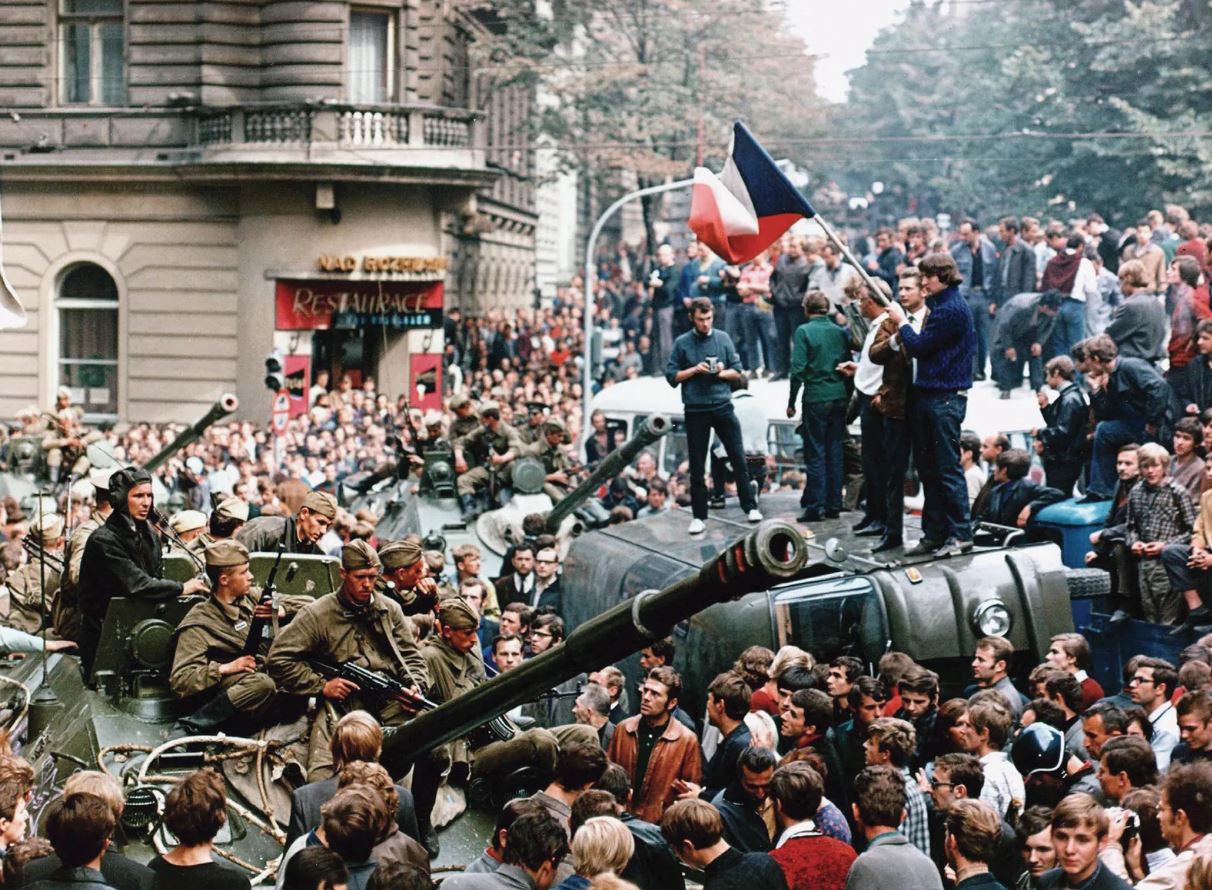
The death of Stalin in nineteen fifty three opened hopes for relaxation. Leaders in the Kremlin spoke of peaceful coexistence, yet uprisings in East Berlin, Budapest, and later Prague revealed how fragile the promise was. Tanks rolled to silence reform movements, proving that sovereignty inside the Soviet sphere was an illusion. In the West, artists, students, and intellectuals debated the ethics of fear, while governments continued to arm. Peace remained the word used to describe preparation for catastrophe.
Sputnik and the conquest of orbit
When the Soviet Union launched Sputnik in nineteen fifty seven, the beep from the satellite echoed louder than artillery. It signaled not just scientific success but strategic reach, since the same rockets could deliver warheads across continents. The United States responded with its own space program, and the competition extended into classrooms and laboratories. The Space Race became a theater where prestige replaced territory. Human achievement grew out of rivalry, and technology advanced because fear demanded it.
Cuba and the brink of annihilation
In nineteen sixty two, the discovery of Soviet missiles in Cuba brought the world closer to nuclear war than ever before. For thirteen days, the superpowers balanced on calculation and restraint. American naval forces blockaded the island, Soviet ships advanced, and messages crossed the Atlantic with the weight of civilizations attached. Compromise ended the crisis, removing missiles from both Cuba and Turkey. The near disaster taught both sides that deterrence required communication as much as strength. Hotlines replaced silence, and arms control began to replace unregulated expansion.
Vietnam and the cost of ideology
The struggle in Southeast Asia grew from local revolution into superpower proxy. The United States entered to contain communism, while the Soviet Union and China provided aid to the North. The jungle war eroded confidence at home, revealing that military power cannot always translate into political success. Napalm and protests burned equally bright, one on foreign soil, the other in American streets. When Saigon fell in nineteen seventy five, the Cold War gained its first symbolic defeat for the West, though neither bloc gained peace from the lesson.
Détente and the handshake across the divide
The nineteen seventies saw a cautious reduction in hostility. Treaties such as SALT I and the Helsinki Accords formalized restraint and recognized European borders as settled realities. Nixon’s visit to Beijing and Moscow turned rivals into negotiating partners, proving that diplomacy could coexist with rivalry. Yet détente was fragile, built on mutual exhaustion rather than trust. Regional conflicts in Africa and the Middle East continued to burn under the supervision of distant powers. The handshake was real, but the fingers remained tense.
The Afghan invasion and the return of frost
In nineteen seventy nine, Soviet forces entered Afghanistan to prop up a faltering ally. The move shattered the illusion of restraint and revived fears of expansionism. Western nations boycotted the Moscow Olympics, armed local resistance, and renewed sanctions. The war drained Soviet resources and morale, becoming their version of the quagmire the United States had known in Vietnam. Each superpower now carried scars from trying to impose ideology through force on foreign terrain. The Cold War resumed its chill with new intensity.
The technological arms race and the economy of fear
By the early nineteen eighties, weapons multiplied faster than reason. The Strategic Defense Initiative promised shields against missiles, while submarines and bombers circled the planet in endless readiness. The expense of perpetual preparation began to weigh on both systems. The Soviet economy, already strained by central planning, could not keep pace with Western innovation. Computers, satellites, and communication networks formed a new battlefield where information replaced artillery. The Cold War entered its digital prelude, a contest of code and calculation.
Reform, rebellion, and the voice of the street
Mikhail Gorbachev’s ascent in nineteen eighty five introduced policies of openness and restructuring that sought to revive socialism through transparency. Instead, the light revealed decay. Citizens from Warsaw to Tallinn organized movements demanding autonomy. Poland’s Solidarity union, long suppressed, gained momentum. Hungary opened its borders, and the Berlin Wall, symbol of division for a generation, fell under the weight of peaceful crowds in nineteen eighty nine. The visual of hammers breaking concrete marked more than a city’s reunion; it announced the unraveling of the Soviet system itself.
The final years of a divided world
As the Eastern bloc dissolved, the Soviet republics claimed independence. Gorbachev’s vision of reform could not hold against the tide of nationalism and economic collapse. In December nineteen ninety one, the Soviet Union ceased to exist, leaving Russia as its successor. The Cold War ended not with surrender but with exhaustion, the implosion of a structure built on control that could no longer sustain itself. The nuclear arsenals remained, but the ideological battlefield closed, leaving behind questions about victory and consequence.
Legacy in the shadows of peace
The decades that followed carried the residue of rivalry. Former satellite states joined Western alliances, seeking security in the institutions once designed to contain their past overseer. Nuclear arms treaties reduced but did not erase stockpiles. Veterans of espionage entered politics or vanished into anonymity. Technology born of competition now serves civilian life, from satellites that guide flights to research that cures disease. Yet mistrust lingers, reminding nations that peace requires maintenance no less diligent than war once demanded.
The culture of fear and the shaping of identity
Art, cinema, and literature mirrored the anxieties of their era. Films imagined apocalypse, novels questioned loyalty, and music turned protest into anthem. The Cold War seeped into daily consciousness, teaching generations to live under the quiet arithmetic of potential destruction. At the same time, scientific progress flourished through rivalry. Space exploration, medical innovation, and computer science advanced as governments sought prestige through discovery. Fear and progress traveled together, inseparable twins of an age defined by contradiction.
Echoes in modern geopolitics
Though the superpower standoff ended, its structure of suspicion persists. Proxy conflicts, intelligence disputes, and information warfare echo the strategies of the past. Nations now compete through economics, cyber systems, and influence networks instead of direct confrontation. The vocabulary has changed, but the grammar of power remains. Historians continue to debate whether the Cold War ended or simply evolved into a new form hidden behind different technologies and alliances. The patterns of containment and persuasion still trace faint lines on every map.
The frost that never fully melted
The Cold War taught humanity that survival depends on dialogue and restraint more than on victory. Its story is not only about nations but about the balance between fear and reason that keeps civilization from ruin. Though the iron curtain has lifted, its memory warns that ideology, when armed with certainty, can chill even the warmest ideals. The frozen decades remain a mirror for every generation that inherits the task of keeping peace alive in a world still haunted by its reflection.