

Ink That Changed the World
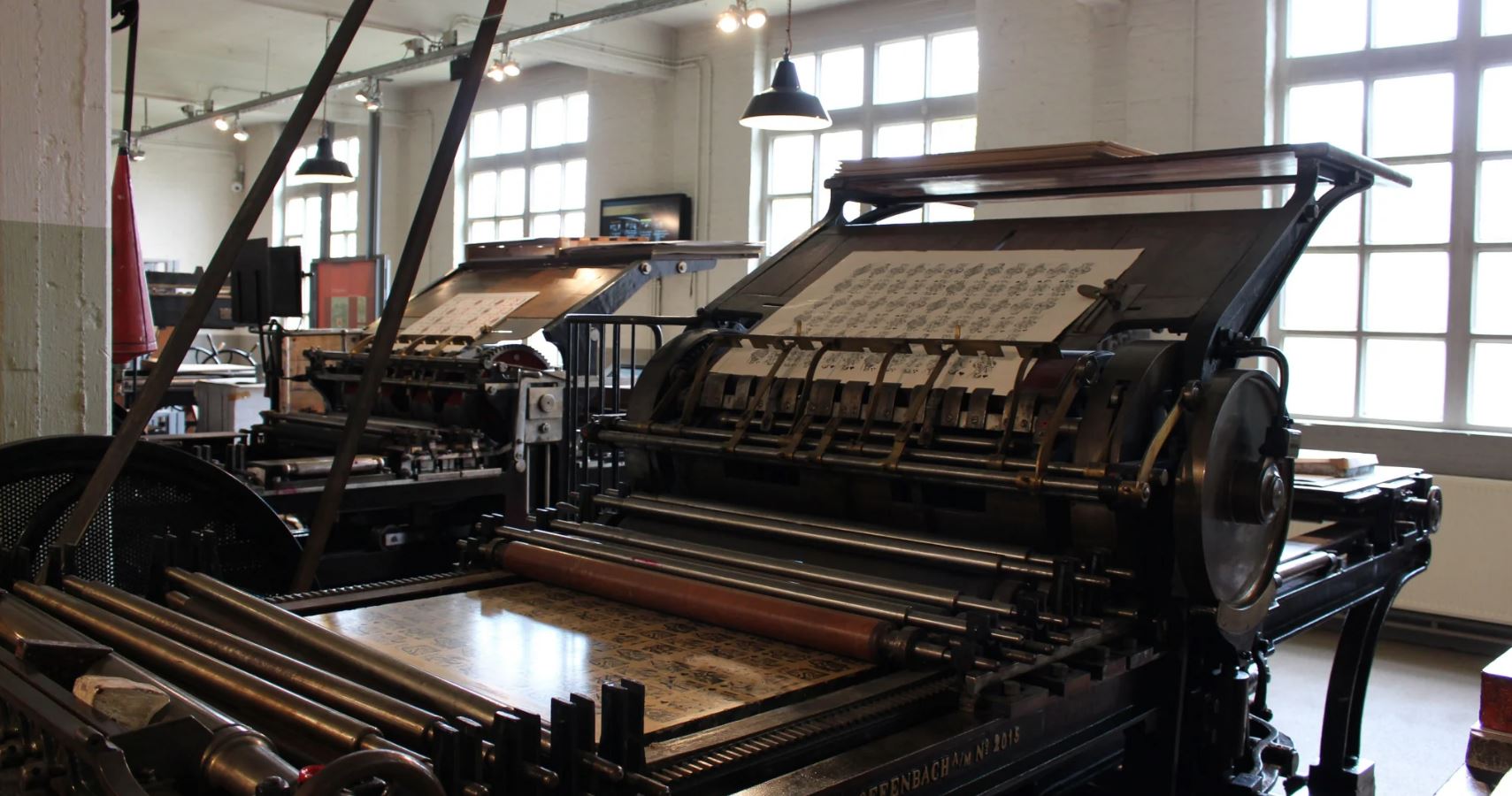
The humble press reshaped faith, science, and the rhythm of knowledge across continents
Whispers before the press
Before printed pages multiplied across tables and markets, words lived inside memory or parchment. Scribes copied manuscripts in candlelight, bending over vellum with patience that blurred seasons into sentences. Knowledge moved slowly, chained by labor and material cost. Libraries were rare and monasteries guarded texts as treasures. Ideas traveled by voice, by pilgrimage, or by rare duplication, and error grew with each retelling. The scarcity of books made education an inheritance of the few, while the many listened from pews or market squares, learning through story rather than study.
Early attempts at mechanical reproduction
Centuries before Europe’s breakthrough, artisans in China and Korea experimented with movable type. Wooden blocks and clay characters pressed ink into paper, allowing officials to reproduce documents faster than the human hand could manage. Yet these systems faced limits of complexity, since thousands of symbols demanded storage and organization. In Europe, where alphabets used fewer letters, conditions were ripe for a simpler and more adaptable solution. Metalwork, oil based inks, and improved paper formed the material foundation upon which invention could flourish.
Gutenberg and the marriage of metal and imagination
In the mid fifteenth century, Johannes Gutenberg of Mainz combined known crafts into an unseen harmony. His movable metal type allowed each letter to be cast, arranged, and reused with accuracy that preserved uniformity from page to page. A screw press borrowed from winemaking provided steady pressure, and oil based ink adhered to paper with durability. The first great product, the Gutenberg Bible, embodied both art and efficiency. Its pages balanced beauty with reproducibility, proving that mass communication could still feel divine. The printing press did not simply duplicate text, it democratized permanence.
The spread of presses and the rise of print culture
Within decades, printing houses appeared in Venice, Nuremberg, Paris, and London. Journeyman printers carried techniques across borders, adapting fonts to local languages and customs. Cities competed to host presses because they drew scholars, merchants, and translators. Booksellers replaced scribes as mediators of learning. The flood of affordable volumes transformed literacy from a clerical skill into a civic one. Reading aloud gave way to silent study, and privacy entered intellectual life. For the first time, an individual could commune with distant minds without needing permission or patronage.
Religion rewritten in ink
The press arrived in an age of religious ferment. Martin Luther’s Ninety Five Theses spread faster than any previous reformist tract because printing turned each copy into a source of more copies. Pamphlets, sermons, and translations of scripture circulated among people who had never owned a book. The Reformation owed as much to movable type as to theology, since it enabled argument to outpace suppression. Churches printed catechisms, opponents answered with counter tracts, and belief became a matter of personal reading rather than institutional decree. Faith met literacy, and neither would ever be the same.
Science in the age of reproducible knowledge
Before print, discoveries often died with their discoverers or lingered in handwritten notes inaccessible to peers. The press turned observation into record and record into foundation. Scholars published journals that invited scrutiny and correction, birthing the modern habit of citation and replication. Diagrams of anatomy, astronomy, and mechanics could now reach students in every university at nearly identical scale. The cumulative nature of science depends on this consistency. Each generation inherits the verified understanding of the previous one, not through trust in authority, but through shared text that can be tested again.
Commerce and the acceleration of information
Merchants quickly saw profit in paper. Price lists, maps, and almanacs appeared in mass, guiding trade with data once restricted to guild masters. Stock exchanges began to rely on printed bulletins, while explorers published accounts that inspired further voyages. The printed world intertwined with the marketplace, proving that information could be currency. Stationers evolved into publishers, and the press became a machine not only of enlightenment but also of enterprise. The rhythm of printing matched the pulse of commerce, both feeding on repetition and reach.
Politics and the birth of public opinion
Governments and rebels alike discovered that ink could rally or restrain. Broadsheets carried news of wars, taxes, and treaties to populations once excluded from politics. Printers became both servants and subversives, depending on who paid for their paper. Censorship followed invention as predictably as shadow follows light, yet suppression rarely kept pace. The printed word crossed borders rolled in wagons or sewn into coats. Political identity began to rely on shared reading, and the notion of a public, citizens linked by awareness, emerged from stacks of affordable pamphlets.
Education and the architecture of learning
Universities reorganized curricula around printed textbooks, replacing dictation with discussion. Teachers shifted from transcribing authorities to interpreting them. Literacy expanded through grammar schools funded by towns rather than monasteries, and students carried personal copies of works that once required permission to view. The habit of marginal notes turned readers into participants. Each generation could now speak directly with Aristotle, Cicero, or Virgil through editions that preserved their voices faithfully. Learning became a dialogue across centuries, bound by the durability of ink and paper.
Art, design, and the language of type
Typography became a new art form. Printers like Aldus Manutius designed italics to save space and improve legibility, while engravers decorated title pages with elaborate borders that blended word and image. The visual rhythm of text influenced architecture and painting, as artists borrowed grids and symmetry from printed layouts. Books grew not only in content but in beauty, embodying the harmony between function and form. The printed page became a stage where letters danced, balancing efficiency with elegance.
Women and the widening circle of readers
Access to books altered gendered boundaries of education. While literacy had long favored men, the affordability of print opened opportunities for women to read, write, and publish. Female poets and essayists found audiences beyond salons and private correspondence. The printed letter made domestic reflection into public discourse, and early feminist thought found footholds in pamphlets that questioned tradition. Reading clubs and salons emerged as spaces where ideas moved freely across social ranks, carried by pages rather than by titles.
Printing beyond Europe
As exploration expanded, presses followed ships into colonies and trading ports. Missionaries printed scriptures in local languages, governments issued decrees, and scholars documented native grammars. While these actions often carried the arrogance of empire, they also preserved languages that might otherwise have vanished. Printing became a dual force, spreading both control and preservation. In Asia, Africa, and the Americas, local printers eventually reclaimed the technology to articulate their own voices, using the same machines once employed to silence them.
Revolutions born in pamphlets
By the eighteenth century, the printing press had matured into an instrument of revolution. The American colonies distributed pamphlets like Common Sense to justify independence. France witnessed newspapers and tracts that mobilized citizens against monarchy. Ideas of liberty, equality, and fraternity leapt from presses into crowds. Authority could no longer contain dissent by controlling speech alone, because the page multiplied faster than censorship could burn. Revolt learned to write before it learned to fight.
Industrial printing and the machine age of words
The nineteenth century replaced hand presses with steam driven cylinders capable of producing thousands of sheets per hour. Newspapers became daily necessities, serialized fiction reached millions, and advertising turned reading into consumption. The telegraph fed newsrooms with instant updates, while photography introduced images alongside text. Printing houses swelled into factories, and literacy became a prerequisite for modern citizenship. The partnership of mechanics and letters created a world where ignorance was a choice rather than an inevitability.
The press in the digital mirror
Electronic media inherited both the ambition and the anxiety of Gutenberg’s invention. Screens replicate the function of type but exceed its speed. Yet the logic remains identical, encoding words into patterns that can be copied without loss. The digital revolution echoes the fifteenth century in scale and consequence, collapsing distances between writer and reader once again. What differs is tempo, since messages now travel in seconds rather than in days. The printing press taught humanity how to multiply meaning, and the network age simply accelerated that lesson beyond measure.
Preservation, decay, and the endurance of print
Centuries later, libraries still protect early books with care, proving that physical text resists obsolescence. Paper, if crafted well, can outlive devices and formats. The tactile act of turning pages connects readers to a lineage of motion that screens cannot replicate. Print retains authority through its slowness, inviting attention rather than distraction. Even as pixels dominate, presses continue to run, ensuring that thought remains tangible. Preservation is not nostalgia, it is continuity safeguarded by craftsmanship.
The philosophy of permanence
Printing altered more than literacy, it changed the way humanity perceives time. Oral cultures live in the present of repetition, manuscript cultures in the patience of lineage, but print cultures inhabit permanence. Once written and distributed, an idea acquires autonomy beyond its maker. Every copy becomes an ambassador of memory, independent yet identical. The press created a form of immortality available to anyone who can write and persuade, an immortality measured not in stone but in circulation.
Legacy of the printed mind
Modern institutions owe their structure to the stability of print. Law depends on reference, science on reproducibility, democracy on informed choice, all of which require durable text. The press provided not only books but also bureaucracy, record keeping, and education systems capable of scaling with population. It bridged solitude and community, allowing private study to fuel public discourse. Even in a world dominated by algorithms, the printed page remains the foundation upon which digital thought stands.
Challenges to credibility and authorship
Mass production of text introduced new puzzles of trust. Forged editions, plagiarized ideas, and sensational pamphlets blurred truth with fiction. Readers learned to verify sources and publishers learned to guard reputation. These habits laid the groundwork for modern journalism and peer review. The printing press forced societies to develop skepticism as a civic skill, proving that progress in knowledge always requires discernment as its partner.
Printing as a metaphor for equality
When every copy holds the same words, hierarchy loses one of its strongest defenses. Print made uniformity a virtue, implying that truth should look the same regardless of who reads it. This equality of access reshaped morality and politics alike. Literacy empowered individuals to interpret, question, and dissent. Each press run echoed a quiet promise, that wisdom belongs to no single class or creed, only to those willing to read.
The rebirth of craft in modern printing
In recent decades, artisans have revived letterpress and fine printing, treating each page as sculpture rather than mass product. Limited editions celebrate texture, impression, and hand mixed ink. The revival honors both nostalgia and resistance, reminding audiences that speed is not the only measure of progress. Craftsmanship endures because the human eye still delights in imperfection made by intention. The press, like music, can be mechanical and still feel alive.
The printed future that remains unwritten
Technologies will continue to evolve, but the principle of reproduction will persist. Whether ink or code, the desire to share thought universally defines the species. The next revolutions may print data in molecules or light, yet they will still trace their ancestry to Gutenberg’s first page. The printing press revealed that knowledge multiplies faster than control and that communication is civilization’s most enduring invention.
The quiet pulse of ink and memory
Every book ever opened repeats the gesture that began in Mainz, fingers lifting paper to reveal another thought preserved in pigment. The press did not merely change communication, it changed consciousness, teaching humanity that memory can live outside the mind yet still feel personal. In every page, the heartbeat of that revelation continues, steady and soft, reminding readers that history is printed not only on paper but on the will to remember.