

Calendars Learned the Sound of Thunder
A year by year journey through a conflict that reshaped borders, ideas, and the measure of loss
Storm signs before the first shot
Industrial rivalry, colonial tension, and alliance promises created a landscape where a local quarrel could pull in distant capitals. War plans sat in sealed envelopes while newspapers praised progress and parades filled boulevards. Railways promised rapid movement that earlier generations could not imagine, and generals believed speed would mean decision before winter. Beneath the optimism stood fear, that a slow mobilization would invite disaster, that any delay would forfeit initiative, and that the next crisis might require a leap rather than a pause.
June and the spark in Sarajevo
On June 28, 1914, shots on a city street shattered a royal car window and changed the balance of Europe. The assassination of Archduke Franz Ferdinand and his wife set chancelleries to urgent work. Some advisers recommended caution, others urged a hard line, and the victim’s death became a test of credibility for a monarchy that worried about its future. Sympathy did not prevent calculation. Each capital asked what allies would do, and every answer rested on older promises that now felt uncomfortably specific.
July became a corridor without exits
Ultimatums replaced conversation as July moved toward its final days. Vienna drafted terms that Belgrade could not accept without surrendering authority. Saint Petersburg weighed partial mobilization and found the idea unworkable once trains began to roll. Berlin promised support to Vienna while London searched for a conference that might stop the clock. The lines that diplomats had drawn in calmer months became rails that carried nations toward an outcome few truly wanted yet many believed they could manage.
August and the wheels of movement
In early August, declarations arrived in quick succession. Germany crossed into Belgium to reach France, Britain entered the war after protests over violated neutrality, and the continent learned the speed of modern mobilization. Soldiers cheered from carriage windows, families waved flags on platforms, and timetables sent millions to fronts that would harden into trenches before autumn. The promise of a short campaign evaporated as firepower outpaced movement and as staffs revised maps that no longer matched their plans.
The Marne and the first halt
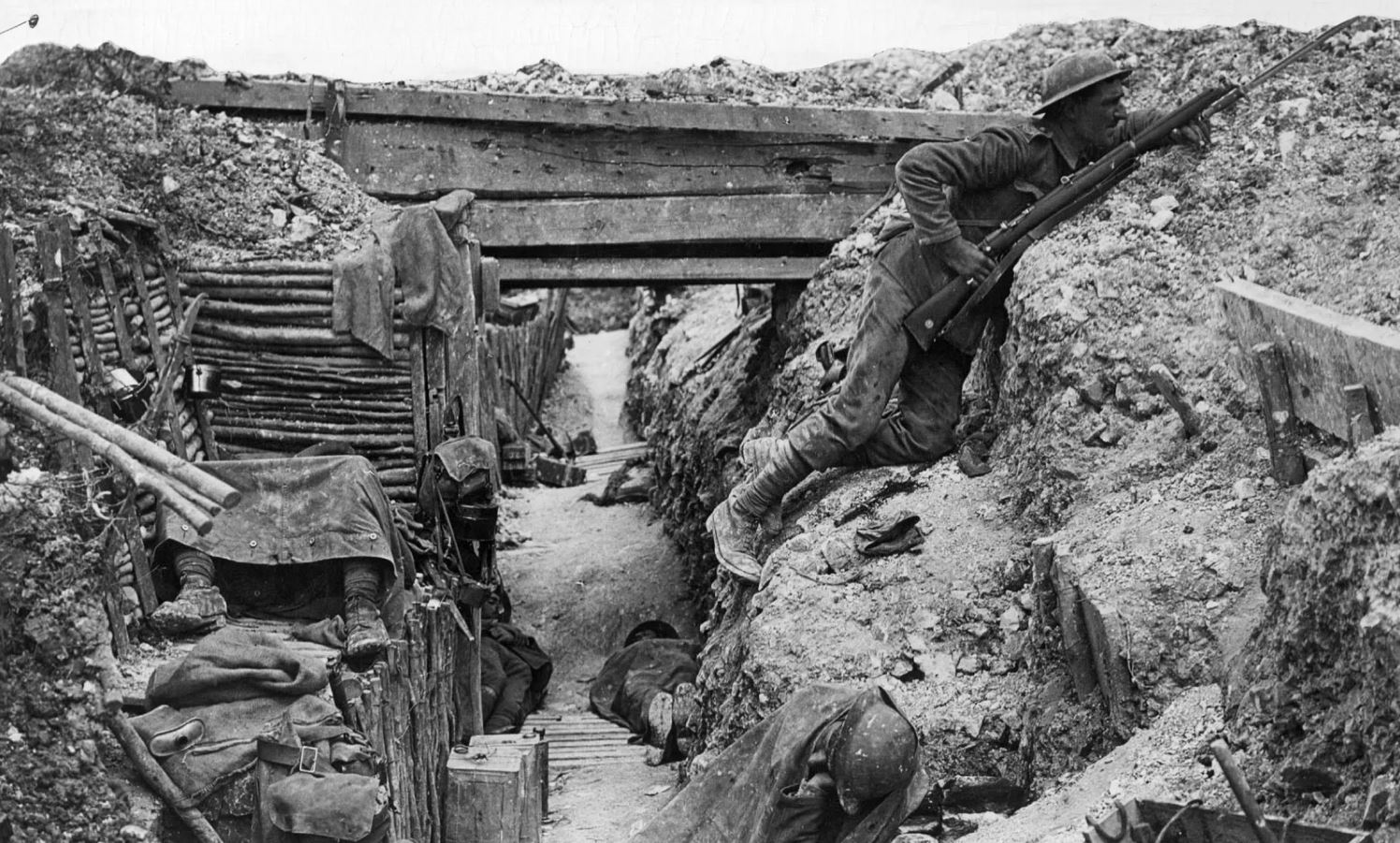
By September, the German advance stood near Paris, and the French command used taxis and trains to move troops into the right place at the right hour. The counterstroke along the Marne forced a retreat that saved the capital and surprised both sides. The race to the sea followed, as each army tried to outflank the other until the Channel ended the maneuver. Spades, sandbags, and wire became the tools of survival, and the Western Front settled into a line that would barely move for years.
Eastern fields of fire
While the west dug in, the east remained a theater of movement. Russian armies entered East Prussia and Galicia with mixed fortunes. At Tannenberg and the Masurian Lakes, German commanders used rail and intelligence to defeat larger forces, while Austro Hungarian units struggled in the south. Towns changed hands, prisoners filled columns along muddy roads, and the sheer scale of distance created a war that felt different from the crowded trenches of Flanders.
Seas watched by steel and signal
The Royal Navy placed a distant blockade on the Central Powers, and surface fleets measured each other with caution after an early clash off the Heligoland Bight. Submarines began to test new rules that the old law of the sea did not fully anticipate. Wireless sets linked ships to admirals and admirals to governments, and the ocean turned from a highway for commerce into a chessboard where a single mistake could sink a fortune along with a crew.
Winter at the front and the first lessons
By the end of 1914, soldiers learned to live in mud with routines that mixed danger and boredom. Trench lines grew elaborate with dugouts, traverses, and listening posts. Artillery taught both fear and respect, for shells could arrive without warning and yet careful counting could predict patterns. Across the wire, enemies sometimes heard familiar songs and languages, and Christmas brought brief moments of quiet that revealed the human cost beneath the uniforms.
New theaters and the gamble at Gallipoli
In 1915, Allied leaders tried to break the stalemate by striking the Ottoman Empire. Naval attacks in the Dardanelles failed against mines and shore guns, and landings on the Gallipoli peninsula trapped brave divisions on steep ground under watchful rifles. Heat, flies, dysentery, and stubborn defense turned ambition into attrition. Evacuation in the winter preserved lives but conceded that courage without a clear plan cannot unlock narrow straits guarded by determined troops.
Italy enters and mountains catch fire
Italy joined the Allies in 1915 after bargaining for territory, and the Isonzo River valley became a place where cliffs and karst punished every advance. Repeated offensives seized little ground at heavy cost. Engineers hung roads from rock faces, mule trains climbed paths that seemed impossible, and winter struck with a cruelty that matched shellfire. The front taught Europe that glaciers could be battlefields and that altitude multiplies hardship.
Gas, masks, and the chemistry of fear
April 1915 near Ypres, clouds of chlorine sent defenders reeling, and the battlefield gained a new terror. Within months, armies carried respirators, trained signalers to warn of attacks, and developed shells that delivered other compounds. Science responded to science with filters and drills. Though gas rarely decided a major battle, it shaped memory because it turned air into a threat and because victims carried injuries that doctors struggled to heal.
Verdun and a year defined by endurance
In 1916, a German assault at Verdun sought to bleed the French Army, while France vowed that the fortress city would not fall. The struggle lasted months, with forts lost and retaken, with units rotated through a furnace that consumed strength and spirit. The phrase they shall not pass became a promise kept at tremendous price. Artillery dominated, infantry clung to shell holes, and the sacred road kept supplies moving day and night under constant strain.
The Somme and the learning of machines
Allied forces opened a great offensive on the Somme to relieve Verdun and to wear down the enemy. The first day brought tragic losses, yet the campaign evolved as commanders adapted to modern fire. Creeping barrages improved timing, small units learned to use cover, and in September the battlefield saw the debut of tanks that crawled across trenches and wire. The machine did not end the war, but it hinted at a new grammar of attack that later years would refine.
Brusilov’s stroke in the east
In the summer of 1916, the Russian Army led by General Brusilov achieved a powerful breakthrough against Austro Hungarian lines in Galicia. Careful preparation, short bombardments, and surprise in sector choice yielded gains that alarmed Berlin and relieved pressure on allied fronts. Logistics and casualties eventually slowed the advance, yet the operation showed that tactical innovation could puncture even strong defenses when planning matched courage.
Submarines and the widening of the war
Merchant ships faced torpedoes from unseen attackers as Germany expanded its submarine campaign in 1915 and again in 1917. Neutral outrage grew as passengers and crews perished. Diplomatic notes, promises, and violations followed in a cycle that frayed patience in Washington. Insurance rates climbed, convoys returned as a protective measure, and new listening devices began to change the odds. The sea war reached into counting houses, kitchens, and cabinet rooms far from the spray.
Home fronts and the invention of total effort
States learned to manage coal, grain, and steel by decree. Women entered factories, offices, and farms in greater numbers, while children stood in queues that measured policy in hours of waiting. Ministers balanced ration books against strategy, and propaganda offices shaped stories that kept families hopeful and steady. The boundary between civilian and soldier thinned, not by law alone, but by the practical demands of shells, ships, and uniforms.
Revolution overturns an ally
In 1917, Russia staggered under strain, and protests in Petrograd grew into a movement that ended imperial rule. A provisional government tried to continue the fight, but discipline eroded and councils of soldiers and workers demanded peace and bread. A second upheaval placed power in new hands that soon sought an armistice. The Eastern Front began to dissolve, and trains carried prisoners and deserters back to villages where hardship had already rewritten daily life.
America enters and a new timeline begins
Also in 1917, the United States declared war after months of tension at sea and after debates about principle and security. Mobilization created camps across the country, shipyards expanded, and credit flowed to allies through large loans. American troops reached the front in growing numbers, bringing energy and fresh divisions that relieved exhausted formations. The calendar now carried a promise that resources and manpower would tip the balance if allies could hold through another year.
Passchendaele and the weight of water
Late 1917 in Flanders, shells broke drainage and rain filled craters until fields turned into a sucking morass. The push toward Passchendaele village became a synonym for struggle in mud, where men and horses vanished and guns sank. Despite small gains and eventual capture of the ridge, critics questioned the cost, while veterans remembered the smell of wet earth and cordite more vividly than any map line.
Skies as a new front
Aviation moved from scouting to fighting and bombing within a few seasons. Pilots learned to maneuver in three dimensions, observers mastered cameras and wireless, and factories produced aircraft in batches that grew each month. Balloons watched for movement, anti aircraft guns filled the air with shrapnel, and civilian towns glimpsed the future when air raids brought war to rooftops and streets. The sky became a ledger of risk and innovation that both sides studied with intensity.
Spring offensives test the line
In 1918, with Russia gone from the war, Germany shifted divisions to the west and launched a series of powerful blows before American strength reached its full weight. Stormtroop tactics used brief bombardments and infiltration to bypass strongpoints and to disrupt rear areas. Towns fell, supply dumps burned, and the Allies bent under pressure but did not break. A unified command improved coordination, reserves moved with purpose, and short victories failed to become a decision.
Hundred Days and the return of movement
Starting in August 1918 near Amiens, Allied attacks combined tanks, artillery plans, and air support to push the front back at a pace unseen since the opening weeks. German units retreated to successive lines that could not be held for long as morale flagged and supplies dwindled. Rail junctions fell, canals were crossed, and the Hindenburg Line cracked under repeated strikes. The strategy focused on relentless pressure across a broad front that denied the enemy time to reset.
Armistice and the quiet that sounded like thunder
Political upheaval in Berlin, naval mutinies, and appeals from exhausted troops brought talks that moved faster than anyone expected a month earlier. On November 11, 1918, guns ceased at the eleventh hour, and men who had survived years in trenches stood in silence that felt unreal. Families celebrated and mourned in the same rooms, because joy could not erase names that would never answer a knock again. The war ended in sounds of bells and in the whisper of leaves falling on empty roads.
Treaties, borders, and the price of paper
Peace conferences drew new lines and wrote clauses that punished, compensated, and promised a different future. Empires dissolved into successor states with hopes that often exceeded resources. Loans, reparations, and mandates linked continents in new ways. Delegates argued over phrases that would bind millions, while outside the halls people dealt with food shortages and with a pandemic that traveled faster than any courier.
Remembrance and the work of naming
After the war, communities erected memorials that listed the fallen in stone so that families could visit a place even when graves lay far away or remained unknown. Veterans formed associations that offered help and friendship to those who could not forget the sound of barrages. Writers and artists tried to shape memory so that future citizens would learn caution without losing compassion. The chronology did not end with an armistice, it continued in how nations remembered and in how they cared for the living.
What the calendar leaves unsaid
Dates can map movement, yet they cannot hold the weight carried by a letter home or by a hand that steadied a comrade on a fire step. The story of the war is a sequence of events, it is also an account of choices made by people who woke each day and did what they believed was necessary. A careful timeline honors both truths, the public turn of history and the private courage that made each line on the map possible.